Showing posts with label chesapeake bay foundation. Show all posts

Thursday, July 11, 2013

Virginia makes progress on the Chesapeake Bay but work remains

Virginia and all the Chesapeake Bay states are making progress on reducing pollution flowing into the bay, but no state has achieved all their 2013 goals. The Chesapeake Clean Water Blueprint lays out the plan for restoring rivers, streams, and the bay itself. In 2009 the bay jurisdictions created two-year milestones to provide transparency and accountability.

Virginia set eight goals and, according to the analysis done by the Chesapeake Bay Foundation and the Choose Clean Water Coalition, is meeting five. Stream fencing and urban stream restoration made significant progress and exceeded targets while stormwater ponds, wastewater treatment plants, and forest buffers are on track. Among the areas that the Commonwealth needs to redouble efforts are planting grass buffers along farm streams and constructing urban infiltration projects. As Jacob Powell of the Virginia Conservation Network noted, "it is clear that Virginia must now commit to investing in a modern stormwater infrastructure the same way it has committed to our wastewater infrastructure."

For more information check out the Chesapeake Bay Foundation's press release that highlights the progress being made and has links to the individual state reports. Let your state legislators know that you appreciated the work that has been done and ask them to uphold Virginia's promise to finish the job of cleaning up our creeks, rivers, streams, and the Chesapeake Bay.

Thursday, April 25, 2013

The message of the smallmouth bass

Read the 2013 smallmouth bass report
The smallmouth bass, a prized freshwater sport fish of the Shenandoah and many other rivers of the Commonwealth, is sending us a loud and clear message -- the same pollution that is killing fish is damaging water quality and the Chesapeake Bay.

You may remember smallmouth bass deaths and lesions in the North Fork of the Shenandoah in 2004. The very next year fish died in a 100 mile stretch of the South Fork of the Shenandoah River. In 2008 fish deaths and disease were reported in the Cowpasture River.

Smallmouth bass don't do well in polluted waters, hence they are an early indicator of declining water quality. Many fisheries biologists believe a toxic brew of contributing factors is decimating this sensitive species. Among the factors are high nitrogen and phosphorus levels in rivers and streams spur the growth of parasites and feed algal blooms that raise pH levels while reducing oxygen in the water. Rising water temperatures and endocrine disrupting chemicals also appear to play a role.

Smallmouth bass fishing isn't just a sport and popular leisure activity, it is an important part of Virginia's economy. Some 2,200 jobs with wages totaling about $74 million annually are supported by smallmouth bass fishing. It also generates about $17 million in state and local taxes.

The good news is that something can be done about it and smallmouth bass have actually made a comeback in the Shenandoah River (see page 9 in the report). Read the Chesapeake Bay Foundation's Smallmouth Bass Report: Angling for Healthier Rivers to learn more about what needs to be done. Let your elected officials know that clean water is important to you and our communities. Get involved with groups such as the Chesapeake Bay Foundation and Friends of the Shenandoah River to find out what you can do in your home and community to protect and improve water quality. The smallmouth bass, and all of us, depend on clean water.

Wednesday, March 13, 2013

Urban runoff vs clean water

Source: Karl Kleiner
York College of Pennsylvania
Urban runoff, a toxic mix of petroleum products, lawn fertilizers, pesticides, and herbicides, antifreeze, and all sorts of other things we humans dump (intentionally or not) on our streets, parking lots, lawns, and gutters causes huge pollution issues for our waters. This pollution can impact drinking water downstream from the urban area. The Potomac, James, York, and other rivers carry this deadly mix to the Chesapeake Bay. Once there, these pollutants can help create marine dead zones that have so little oxygen life is impossible.

The Virginia Department of Conservation and Recreation is conducting a public hearing and receiving comments on Arlington County's application for a new runoff permit that is consistent with the Chesapeake Bay Clean Water Blueprint. At a minimum the permit should require specific and enforceable goals with public accountability, ensure an appeals process in the event goals are not met, require acceleration of local programs to reduce pollution, and demand thorough and regular monitoring.

Arlington the first of the state's largest localities to seek a permit - it will establish a precedent for other localities so it is essential that the standard it sets is high and adequately protects our waters.

The public hearing is at 10:00 AM on March 22 at the Arlington County Government Building. Public comments will be received until March 29.

Learn more about urban runoff and send your comment to the Department of Conservation and Recreation.

Thursday, November 15, 2012

Help save the Chesapeake Bay

Help save the Bay.
Click here to take action.
The menhaden is a very small fish, but its importance to the Chesapeake Bay is huge. Overfishing has left the population at its lowest level on record and since menhaden is primary food source that endangers the entire Bay ecosystem.

The Chesapeake Bay Foundation is pushing fair and reasonable limits and fishing rules:

A 25 percent reduction of the menhaden catch as a first step toward eliminating overfishing. 
Reducing the fishing rate further to achieve the target level within five years. 
To avoid undue financial harm to local fishermen catching menhaden for bait, the allocation plan should split the new quota 70:30 between the industrial fishery and the local bait fishery. 
The Atlantic States Marine Fisheries Commission is considering new fishing rules to ensure long-term protection of this valuable fish. It's accepting public comment only until November 16 so take action now!

Tuesday, August 21, 2012

Port Isobel service/adventure

Last week I joined with about thirty others to visit, learn, and work at Port Isobel, an educational facility of the Chesapeake Bay Foundation (CBF). The 250 acres of island and marshes is located just east of Tangier Island and is shown on nautical charts as East Point Marsh. The educational facility consists of a dorm for up to 30 people and a conference center with kitchen. Living up to its commitment to environmental stewardship, the CBF facility has solar power, composting toilets, and water saving innovations.

Port Isobel as seen from the beach to the east.
We arrived in Crisville, Maryland about noon and loaded our gear aboard the Loni Carol II, a 40-foot Chesapeake Bay workboat for the journey to our island home for the next four days. Since few of us knew each other prior to that day, introductions were made as the Loni Carol II plowed through the Bay during our 45 minute voyage to Port Isobel. Arriving at the dock, teamwork quickly took over as we unloaded our personal gear and food/supplies for the four day stay. After a brief orientation we signed-up for our meal preparation/cleanup shifts and set out to explore the area. Many of us hiked the trail through a stand of bamboo and across the marsh to a small strip of beach... learning quickly that the flies were both numerous and ferocious. After dinner there are get acquainted activities and discussions about challenges facing the Chesapeake Bay.

Sunrise at Port Isobel
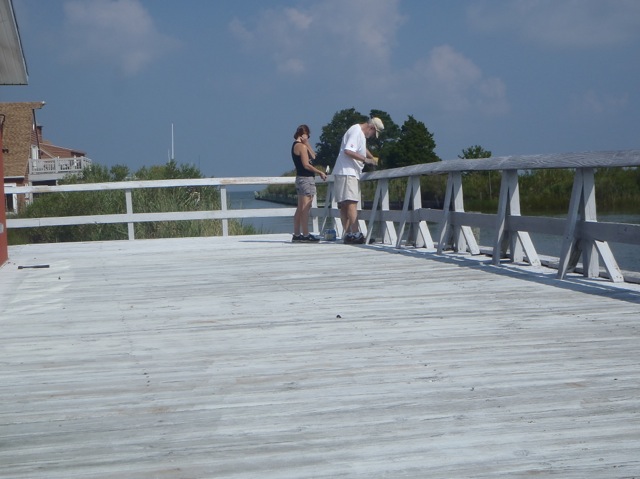
After breakfast on our first full day at Port Isobel we signed up for various repair and maintenance jobs in desperate need of attention. There were trails (laced with poison ivy) to clear and widen; painting of decks, rails, and door/window frames; gardens to weed and mulch; fire pits to build; and much more. Breaking into teams, everyone quickly found the necessary tools and supplies and got straight to work. 

Repairing and painting a deck and railing.
Working closely with others, conversations became lively as we got to know our news friends better. "Where do you live?" "What do you do for a living?" "Why did you pay to come to this CBF work and learn adventure?" This activity was apparently a first for the CBF and was modeled after "volunteer vacations" of the Sierra Club. For two days our mornings and about an hour after lunch would be dedicated to making Port Isobel a more attractive and safer place for students and teachers who visit to learn more about the environment, history, and culture of this national treasure.

Cleaning and mulching gardens.
The afternoons were for learning and adventure. There was canoeing and hiking for some. Others simply enjoyed the scenery and read on the dock. Loading crab pots on the Loni Carol II, we set 15 pots as the captain explained the challenges facing the watermen of Tangier and the environmental issues threatening the blue crab. We learned about the life-cycle of crabs, some history of bay crabbing, and the politics of regulation and crabbing along the Virginia/Maryland line.

After another great dinner (chicken stir fry) we met and had a conversation with Tom Horton, who for over 30 years, covered the environment and Chesapeake Bay for the Baltimore Sun and has authored numerous articles and books about life and culture in the region. Homespun and a great story teller, Horton brought us closer to life and loss in Tangier and Smith Island.

Friday we continued with our assigned jobs... and some new ones... anticipating our afternoon trip to Tangier. Walking the narrow streets, sampling the ice cream, visiting the museum, and chatting with locals gave us just a taste of the very different life of the people of Tangier. Leaving Tangier, we set a course for the crab pots we'd set 24 hours earlier. Our catch yielded about 100 keepers and CBF staff bought another half bushel plus some soft shell crabs and the evening's feast featuring a crab pickin' was on!! One thing was clear about this trip... we ate well... and so did the bugs!
The haul from our crab pots.
Saturday morning. You might think we'd be anxious to get home and away from all the sweat and bugs, but I think everyone was settling into the routine and would have gladly spent another day or two at work, just to stay on Port Isobel and take it all in. After breakfast we again boarded the Loni Carol II and headed for the grass beds for scraping, the process of harvesting soft shell crabs for sale (video). We caught crabs (didn't keep any) and we brought back other fish, shrimp, etc to put in Port Isobel's aquarium.

Sunset at Port Isobel
After a couple hours of cleaning the buildings and grounds, and taking the obligatory group picture, we loaded our gear, recycling, and trash on the Loni Carol II and headed for the marina at Crisfield. The waves and chop were a bit higher than on our trip out so the ride was a bit rougher, wetter, and longer. 
Like everyone, I was moved by what I'd experienced and learned at Port Isobel and intrigued by new friends whose daily lives are so different than my own. Many of the participants were from NOVA or the Baltimore and Annapolis areas... a couple even wondered if where I live is in the Chesapeake Bay watershed (yes, most of the Shenandoah Valley drains into the bay). It was too bad, but perhaps understandable, that not a single participant was from Pennsylvania - the largest contributor of water in the Chesapeake Bay watershed.

Rivers from 6 states and D.C. drain into a
tidal basin that averages just 21' in depth.
Perhaps the greatest lesson is that, in restoring and saving the Chesapeake Bay, as in climate change and all our environmental time bombs, we are all in the same boat. We inhabit the same earth, drink the same water, and breath the same air. Individually we can make a difference by being responsible children of Mother Earth and never, ever taking her for granted in our daily lives. Collectively... by working together and putting aside selfish motivations... we can solve all of these challenges and many more to come.

Thursday, May 3, 2012

Bobblehead Bob and the lunatic fringe

Bobblehead Bob Goodlatte (R-VA06) is at it again. Denying credible science, common sense, and any understanding of cooperative federalism "my congressman" (I may be a constituent but he certainly does not represent me or most of my friends) would throw oil in the waters of cleaning up the Chesapeake Bay.

Let's peek into Bobblehead Bob's Republican world.  It is a strange world in which he marches lockstep to whatever orders come down from the GOP "brain trust." It matters not what is practical, what works, what is for the good of the people. What matters is following the party line even when it is detrimental to folks in the Shenandoah Valley and Virginia. For Bob, it is all about politics and obstruction.

In an April 27 Washington Post column, Let's just say it: The Republicans are the problem, long time political analysts Thomas Mann and Norman Ornstein conclude:
The GOP has become an insurgent outlier in American politics. It is ideologically extreme; scornful of compromise; unmoved by conventional understanding of facts, evidence and science; and dismissive of the legitimacy of its political opposition. 
When one party moves this far from the mainstream, it makes it nearly impossible for the political system to deal constructively with the country’s challenges.
If Republicans are the problem, then their loyal lapdog, Bobblehead Bob, is like a pimple on a compound wart on the notion of American democracy, a clean environment, and human rights. A recent example -  "my representative" introduced H.R. 4153, which through the magic of deceptive Republican double-speak, he dubbed the "Chesapeake Bay Program Reauthorization and Improvement Act." The Chesapeake Bay Foundation called this the "worst piece of legislation affecting the Chesapeake Bay ever introduced in Congress."

Bobblehead Bob Goodlatte has moved so far from the mainstream, even in the conservative Shenandoah Valley, that he is becoming a national embarrassment. This reactionary bill denies solid science, political reality, and any vestige of common sense. Why did he introduce it? Who knows? But is it pretty clear that Bobblehead Bob is beyond thinking for himself - the tea party wingnuts and the Eric Cantoristas pretty much tell him what to do.

Let Bob (or your congressman) know you oppose H.R. 4153 and other Republican bills (H.R. 4337) that will condemn the Chesapeake (and all the rivers and streams flowing into it) to increased pollution and a slow but sure death.

Friday, April 6, 2012

VA's Bay Watershed Plan Falls Short

Map from DCR website.
On March 30, the Commonwealth's Department of Conservation and Recreation (DCR) submitted Phase II of Virginia's Chesapeake Bay Watershed Implementation Plan, (WIP Phase 2) to the EPA. WIP Phase II is intended to guide Virginia's bay restoration activities for the next 13 years, but it is so lacking in specifics, detailed data, and clear locality strategies for implementation that it is, as the Chesapeake Bay Foundation Virginia Executive Director Ann Jennings said, "little more than a statewide wish-list of possibilities that, unless revised, falls far short of providing Virginia citizens with reasonable assurance Virginia can meet its Bay cleanup goals."

Although it runs some 80 pages, WIP Phase 2 (PDF) is filled with vaguely hopeful phrases like "seek opportunities," "promote," and "encourage" and is so lacking in specific implementation actions and targets that it is virtually meaningless. It is kind of like a fellow saying he will graduate from college but not having any specific plans as to how to pay for it, what courses he will take, what major he will pursue, or even what college he will attend. Perhaps this is by design and decree of the McDonnell administration? He and his party have resisted many of the EPA's bay cleanup targets and strategies from the beginning.

The public comment period runs through May 31 - contact DCR and tell them the plan lacks so many specifics it really isn't a plan at all. Tell DCR to describe specific locality-by-locality plans that will make Chesapeake Bay cleanup a reality rather than a pipe dream. You can email comments to vabaytmdl@dcr.virginia.gov or mail them to James Davis-Martin, Virginia Department of Conservation and Recreation, 900 East Main St., 8th Floor, Richmond, VA 23219. Be sure to include your name, address, and phone number in all correspondence.

About 60% of Virginia's land area and more than two-thirds of the state population live the Chesapeake Bay watershed. Major river watersheds draining into the Chesapeake include the Potomac (including Shenandoah), Rappahannock, York and James rivers as well as coastal lands on the bay's shoreline.

Thursday, March 8, 2012

Bob, litter is part of the problem

Rep. Bob Goodlatte (VA-06) has introduced a bill to halt the EPA's Chesapeake Bay cleanup plans. Pointing to "more mandates and overzealous regulations," Goodlatte wants to turn the responsibility over to states and to rely on "voluntary efforts." He also calls for "nutrient trading" programs.

In response, the Chesapeake Bay Foundation issued a statement urging Congress to reject the legislation outright. The CBF said, in part, that the legislation will "undermine the pollution limits currently in place, derail cleanup efforts and undercut the federal government's role in making sure that all Americans have access to clean, swimmable, fishable waters."

Okay, let's keep it simple: Goodlatte's bill would result in uneven enforcement at best and a dirtier Chesapeake Bay. And a more polluted Bay impacts Virginia more than perhaps any other state.

The Chesapeake Bay watershed consists of 64,000 square miles and drains portions of six states (Virginia, Maryland, West Virginia, Pennsylvania, Delaware, and New York) and the nation's capitol. Leaving enforcement up to each individual state could mean no enforcement at all - Pennsylvania, a major contributor of the Bay's fresh water, might decide there is nothing in it for them and the costs just aren't worth it. So even if Virginia and Maryland made heroic efforts to clean up the Chesapeake Bay, it would all go for naught.

"Voluntary efforts" is laughable. Let's try voluntary speed limits on I-81. It is hard enough to keep trucks and cars at 70 mph with enforcement; can you imagine the chaos if it were voluntary. Drivers who voluntarily comply better have a huge and effective rear bumper! As someone who has waded streams collecting water and macroinvertebrate samples, I have personally visited farms that have voluntarily done wonderful things to stabilize stream banks and to keep excess nutrients and pollutants out of our waters. But, I've also seen that a few miles of protected stream can't make up for the others that continue to allow erosion and waste to spoil our precious water resources.

"Nutrient trading" programs may have some validity in the short term. Polluters who can't clean up as quickly or easily could, I imagine, buy/trade nutrient credits with others who have cleaned up their act. But, in the long term we need everyone to get it right and realize we can't keep treating our waterways as sewers. Besides, "nutrient trading" sounds a lot like "cap and trade" which I thought the congressman and his GOP colleagues detested. A bit of Republican hypocrisy and insincerity on display here?

Cleaning up the Chesapeake Bay will take the efforts of all 17 million Americans who live in the watershed. And I do mean all - while intensive agriculture is a major contributor to excess nutrients and pollution in the Bay we need everyone involved. That means enforceable regulations on homeowners (septic fields and overuse of fertilizers), municipal sewage systems, developers, manufacturers, and businesses large and small.

Want to get involved with water cleanup in the Shenandoah Valley? Check out these organizations doing good work in your community:
You can also contact Rep. Bob Goodlate and let him know you oppose his bill (it is probably more about grandstanding against the EPA and posturing for the election than it is about good public policy). I just squawked at at the old bird.

Friday, December 3, 2010

Chesapeake Bay Cleanup - voluntary won't get the job done

Always drink upstream from the herd.
                                                ~Will Rogers

Earlier this week, Governor Bob McDonnell's administration released its plans for the cleanup of the Chesapeake Bay. To a large extent the plan relies on voluntary actions to clean up the bay. It also provides for a system of buying and selling the right to pollute in certain watersheds - a plan that sounds much like cap and trade, a concept lambasted by many Republicans who care more about protecting business than protecting the environment.

Representative Bob Goodlatte (VA-06) joined Virginia farm organizations in calling for a more "flexible collaborative Bay cleanup effort." In other words the congressman and farmers want a largely voluntary plan with a few economic incentives but without deadlines or meaningful enforcement.

Voluntary always sounds good and sometimes results in meaningful positive steps, but in this case (and in many others) the problem is too big, the number and sources of the pollution to great, and the consequences of inaction too dire for this great natural resource to be restored simply by flexible and collaborative efforts. Action is needed and all (not just those with a conscience) need to be part of the solution.

How well does voluntary action work to end human behaviors that negatively impacts others? Suppose we had a voluntary program to end to drunk driving - think that would be effective? Even mandatory programs, where some find ways to get around the law, eventually find the problem rearing its nasty head after we thought it to be ancient history. For example, some parents figure that if all other kids get their childhood vaccinations, their darlings will be safe even without them. When enough think that way disease can make a quick comeback. Pertussis (whooping cough) cases are on the increase all across the country including cases recently in Orange County, Virginia.

Cleaning up the Chesapeake Bay will require action from all involved - not just farmers, but also households with leaky septic tanks and overzealous lawn fertilization, municipalities with out-of-date sewage treatment plants, and factories and processors who use our waterways to flush away their waste products. With all due respect to Will Rogers, in today's world, there is no place that is upstream from from herd (or bad septic tank).

Having been involved in stream monitoring for the past several years I have come to the conclusion that responsible farmers who are doing the right thing by building livestock buffers, planting vegetation, and restoring steam banks should be saluted but the reality is those efforts are only minimally affecting water quality. Water laden with e-coli and other pollutants may improve but will not magically become clean because it passes through a mile or so of properly managed stream. Bad water in = bad water out. Plus, in our karst limestone region bad surface water can find it way into groundwater affecting private wells and municipal water sources. In short, a few farms (or homes or old sewage plants) can muck up the whole creek.

One impediment to farmers taking the steps to manage streams crossing their fields is cost of fencing and providing water to their livestock. Cost is even more prohibitive and there are economic disincentives if the land is leased. Many landowners wouldn't go through the hassle of getting a grant or putting up the bucks to pay for the fence - it isn't their cows in the stream and the costs probably couldn't be recouped in the rent. The farmer running the livestock on the land may want to keep cows out of streams to reduce hoof problems and keep them grazing, but he'll unlikely to pay for fencing and watering on land he doesn't own.

Nope Rep. Goodlatte, this is one of those cases where voluntary won't get the job done. Too many incentives to not volunteer. And just a few farmers, homeowners, or factories not cooperating for the common good will have a dramatic impact on all of us. I'm all in favor of grants, expert advice, and other assistance to farmers. Those incentives should be designed to move cleanup of our streams, our rivers, and the Chesapeake Bay along faster. There might even be a bit of economic stimulus in doing just that. But at the end of the day, if we are really serious about restoring the Bay, we'll need deadlines, mandates, enforcement, and a common set of rules for all who use (and will potentially abuse) our precious water resources.

Wednesday, June 9, 2010

Cypress Creek - more questions than answers

Old Dominion Electric Cooperative (ODEC), of which Shenandoah Valley Electric Cooperative is a member, has proposed to build a new coal-fired power plant known as Cypress Creek Power Station in the Town of Dendron (pop. 300) in Surry County, Virginia. At a cost up to $6 billion ($9,000+ per household served), Cypress Creek would be the most expensive coal power plant in the country and the largest coal-fired plant in the Commonwealth. ODEC has already spent thousands of dollars in the ongoing permitting process. ODEC defends the plant by stating that coal "is still the least expensive way for us to make sure we have the electricity we need at an affordable price."

Others aren't so sure that ODEC's dollars make much sense. Wise Energy for Virginia commissioned a study by Synapse Energy Economics Inc. The respected analysts concluded that an uncertain economic climate and costs of meeting regulations related to carbon dioxide could mean even higher electric rates for consumers.

Of course, there are costs that aren't always measured in dollars and cents. A Chesapeake Bay Foundation study found that the plant would discharge significant amounts of mercury and other toxins into the James, Pamunkey, Blackwater, Nottoway, and Roanoke rivers and into the Chesapeake Bay. The Chesapeake Bay Foundation says the plant violates provisions of the Clean Water Act. Physicians for Social Responsibility and others have pointed out that air and water discharges from a coal-fired power plant will create a variety of environmental and health problems for the region. Cypress Creek is located just upwind and upstream from one of Virginia's most populated areas - Hampton Roads - which is also one of the state's major tourist destinations.

So far, ODEC has been touting the benefits but has been less than forthcoming about the costs, financial and otherwise, of Cypress Creek. SVEC members should be asking questions and demanding answers. A few of those questions:
  • How much will Cypress Creek cost? What will SVEC contribute? How with this be passed on to customers?
  • With many banks wary of the risks of financing coal-powered plants, how will Cypress Creek be financed? What are the borrowing costs? How will those costs be passed on to SVEC customers?
  • What are the alternatives to a mega coal-fired plant? Have those alternatives been completely explored?
  • Currently there is excess power on the PJM grid and an uncertain economy and greater conservation make future demand uncertain. Do we really need this mega power plant?
  • Since the beginning of the year plans for at least eight coal-fired power plants have been abandoned or put on hold. Most recently it was Wolverine Power Cooperative's plans for a coal-fired plant in Michigan. An air quality permit was denied and the Michigan Public Service Commission concluded that the plant was not needed and "would result in an estimated rate increase of $76.95 per month for the average Wolverine residential customer." What lessons can we learn from that case study? Will Cypress Creek mean customer's rates could increase by 50-60% a month?
  • The ODEC board of directors has yet to vote on the Cypress Creek plant. Why is ODEC moving forward on the project without formal approval of the board?
  • Can ODEC and SVEC assure customers that rates won't go up to pay for Cypress Creek?
Many questions and, so far, few answers from ODEC, SVEC, and the other member cooperatives. As customers of an electric cooperative, we are the owners... it is our cooperative. We should demand answers before ODEC moves forward with Cypress Creek.

Sunday, February 7, 2010

Chesapeake Clean Water Act

The Chesapeake Clean Water Act (HB 3852 and SB 1816) will require all seven jurisdictions whose waters flow into the Chesapeake to implement specific plans for reducing nitrogen, phosphorus, and sediment pollution over the next 15 years. The bill is not just a mandate, it provides the necessary resources to help states and localities achieve its goals. Passage of the Chesapeake Clean Water Act will help assure our rivers and the bay begin the road to recovery. Contact Senator Mark Warner, Senator Jim Webb, and Representative Bob Goodlatte (or the congressman in your area) and encourage them to support the Chesapeake Clean Water Act.
As the Washington Post notes, the act is the Best Hope for the Chesapeake Bay.
Want to learn more? Check out the Chesapeake Bay Foundation.

Monday, November 2, 2009

Putting teeth in bay cleanup

Senator Benjamin Cardin (D-Maryland) has introduced legislation to put some teeth into cleaning up the Chesapeake Bay. Among the provisions:
  • Reauthorize the Chesapeake Bay Program which is run by EPA;
  • States in the 64,000 square mile watershed would have to devise more specific plans to reduce pollution;
  • States would have to write stormwater permitting rules that protect the natural hydrology of an area under development
  • States would have to abide with a watershed-wide "total maximum daily load" limit on nitrogen, phosphorus and sediment.
The legislation also provides $1.5 billion in grants to help states achieve these goals. Starting in 2014, the states would have to issue progress reports every other year. A failure to make adequate progress could result in loss of those funds. There's the teeth!
More about the legislation and cleaning up the bay at the Washington Post and the Chesapeake Bay Foundation.