The good news: The United States is a global leader in reducing carbon pollution as we retire dirty coal plants and replace them with clean, renewable energy. Several states, including South Dakota, Iowa, and Minnesota are getting a significant amount of their electricity from renewable sources.
The bad news: Far from being a leader, Virginia lags behind much of the rest of the country in getting rid of coal and moving to a clean energy future. Dominion Resources continues to stymie efforts to move the commonwealth (Richmond is not only the state capitol, it is also the asthma capitol) to greater use of wind and solar energy. Placing profits above people, the powerful company is aided and abetted by failed leadership in the Executive Mansion and General Assembly.
Get involved: Contact your state legislators and tell them it is time, indeed past time, to move Virginia towards clean and renewable energy. Join the Sierra Club Beyond Coal campaign
One of the really nice things about living in the central Shenandoah Valley is the absence of many biting insects cause welts, itching, and irritation that can ruin early mornings in the garden or an evening on the porch. I can recall many years in which I counted mosquito bites for the entire summer on my fingers and toes. And, we don't have the green head flies and black flies that infest some eastern areas of the commonwealth. It does seem though, that blood sucking politicians are found in all regions of Virginia.
Growing up in Tidewater, I can remember how bad mosquitos were on a sultry summer night. The city had a truck that patrolled neighborhoods fogging the air with some unknown mist to kill the nasty little devils. As kids we were glad to see the relief from itching coming down the road, but in retrospect it was probably some toxic witches brew that, while killing mosquitoes, is responsible for my memory loss in older age. When I stayed in the Valley after college, I didn't miss the mosquitos or flies of my childhood. Visits home often brought painful and itchy reminders of what I'd left behind.
But the nasty little vampires seem to be finding a niche in the Shenandoah Valley, or at least in my backyard, over the past couple summers. Perhaps this summer we can attribute it to the heat along with the rainfall and humid conditions. Many mornings and evenings I'm hit with multiple mosquito bites in just a few minutes. With some hesitation, I break out the Deet bug spray (the only thing that consistently works for me) and keep them at bay while rubbing a little anti-itch ointment on the growing red bumps.
Manmade climate change and global warming may be responsible for some of the recent population increase in these nasty bugs in the Valley. And there is a bigger picture - we may just be on the cusp of a future with more bugs and diseases that aren't familiar to most folks in the U.S.A. An interesting Mother Jones article, 7 Climate Change Diseases to Ruin Your Monday, highlights the science behind climate changes that are creating favorable conditions for odious and dangerous diseases to find their way into your home town. Check out just a few of these disagreeable and gross diseases spread by mosquitos and ticks:
West Nile Virus is spread by mosquitos. No cure.
Lyme Disease is spread by ticks. No cure but antibiotics help many.
Chikungunya is spread by mosquitoes. Currently found in Africa, Asia, and the Indian subcontinent, but is finding its way into Europe. No cure.
Rift Valley Fever is spread by mosquitos. Only experimental cures.
Dengue Fever is spread by mosquitos and has been found in Florida and southern Texas. It may be the most likely disease to spread in the U.S because of climate change.
The link above will give you more information about each disease (and others spread by algae and fungus) including symptoms and the forecast about them potentially spreading to North America.
In the meantime, pass the Deet. Maximum strength! UPDATE - 23 AUGUST According to the CDC, the West Nile outbreak is the largest ever with four times the cases for this time of the year. There have been 41 deaths and 1,118 cases in 38 states - about half in Texas with ground zero being the Dallas area. There are probably many more cases since people with mild symptoms often don't go to a doctor. Ways to avoid the West Nile virus (other than staying away from Texas) include:
Use an effective mosquito repellant;
Wear long pants and long sleeved shirts when outside, especially at dawn and dusk when mosquitos are most active;
Keep screens on doors and windows closed;
Remove standing water from mosquito breeding places like buckets, barrels, and flower pots and change pet and bird bath water every day or so. If your gutters hold standing water, consider flushing weekly.
Richard Mueller, a physics professor at the University of California, Berkeley, has been a very prominent skeptic about the human causes of climate change.
Until Monday.
On July 30, 2012 Mueller, a member of the Berkeley Earth Surface Temperature team said the "evidence has changed my mind." He continued, "Last year, following an intensive research effort involving a dozen scientists, I concluded that global warming was real and that the prior estimates of the rate of warming were correct... I'm now going a step further: Humans are almost entirely the cause."
So what does this have to do with the Shenandoah Valley and Virginia - the focus points of this blog? Everything, ya dumb cluck.
If we are going to slow human caused global warming it will take political initiative, commitment, and concrete actions right here in the commonwealth as well as around the world. One small step is to tell Virginia senators Mark Warner and Jim Webb to show leadership by supporting renewal of the production tax credit for wind power. It will mean jobs for Virginians, cleaner air over the commonwealth, and fewer greenhouse gasses cranking up global temperatures.
The EPA has proposed the first national standard to limit carbon pollution - that's the nasty stuff causing the climate crisis. That weird, dirty weather you’ve been having – blame carbon pollution. Where does this pollution come from? The shocking answer: 40% of all carbon pollution in the United States comes from power plants.
If this rule goes into effect, no new dirty, climate-change-causing power plants will be built.
Will you tell the EPA you support the first-ever limit on carbon pollution? It’s easy. Just sign the petition at The Climate Reality Project to show your support.
Climate change. Water pollution. Over population. Toxic wastes. Carbon and mercury emissions into the atmosphere. Everyone but the fringe science deniers who have become the Republican mainstream agree that these and other threats are challenging our planet and mankind. Now add to that list species extinction.
A recent report in Nature concludes that species extinction is equally threatening to our world and is a significant driver of global change. Studies over the past two decades have shown the biologically diverse ecosystems are more productive in producing life sustaining for all, including humans. The study's lead author, David Hooper of Western Washington University, states
Some people have assumed that biodiversity effects are relatively minor compared to other environmental stressors. Our new results show that future loss of species has the potential to reduce plant production just as much as global warming and pollution.
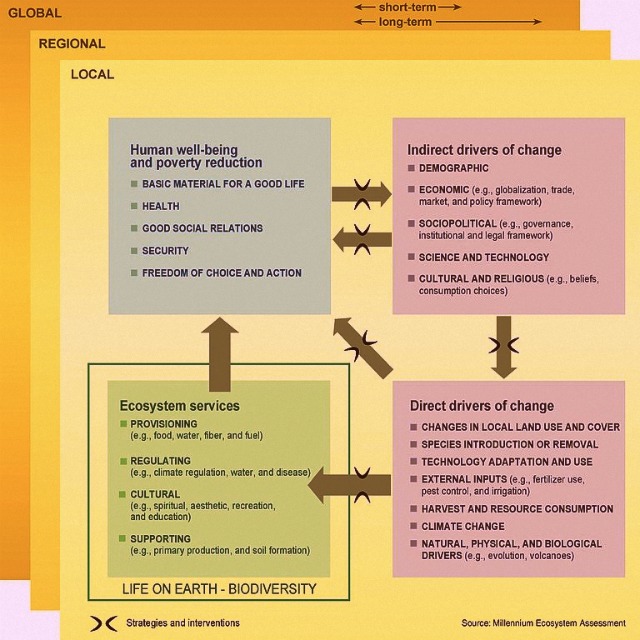
The chart, from Millennium Ecosystem Management, shows the interconnected relationship between biodiversity, ecosystems, and human well-being and illustrates how what we do locally can have far reaching impacts.
In short, what may as a inconsequential loss of a species here and a species there can add up to something larger impacting the life of the entire planet. As Richard Pearson of the American Museum of Natural History recently wrote in The New York Times as he pondered nearly 20,000 species facing extinction in the wild, "This should keep us up at night."
It is a local, regional, and global interconnection and in the pursuit of our interests we often unintentionally or intentionally don't connect the dots. For example, much of the air pollution affecting a national treasure like Shenandoah National Park comes industries and utilities in the Ohio River Valley - why do you think they build those tall smokestacks? So the emissions will be picked up by prevailing winds that carry the toxins away from the source. The dirty air becomes a problem for everybody downwind.
It is the same shortsighted insanity that Rep. Bob Goodlatte's H.R. 4153 would inflict on the Chesapeake Bay. Like many politicians he makes only those connections that have to do with his constant campaign for perpetual reelection. When it comes to restoring the bay he is worse than clueless, he denies scientic facts and the realities of achieving regional goals in our federal system - all for his own political gain.
Species around the globe, even those which you and I may never see, can have dramatic positive benefits for our lives. Don't think a tiny animal on an exotic choral reef could change your life? Think again?
Get involved in your everyday life. Recycle when possible. Nurture wildlife in your neighborhood. Tell your congressman to oppose legislation like H.R. 4153 that would be a tragedy for the Chesapeake Bay. Adopt a choral reef.
This clip from the Institute of Biological Research, Alexander Von Humboldt, Bogotá, Colombia explains the importance of biodiversity.
Old coal-fired generating plants are among the dirtiest polluters in the nation. They cause smog and spew out huge amounts of greenhouse gases, toxic ash, and a variety of chemicals. "Why are they allowed to do it?" you might ask. Because in its wisdom, Congress grandfathered these plants under amendments to the Clean Air Act in a way that created very powerful economic incentives to stay dirty... and get dirtier as they age. After eight years of a purposely impotent EPA, under the Obama administration the agency seems to be moving to updating regulations under the Clean Air Act and other pollution laws. There's more about the dirty deals, the grandfathered polluters, and how the politics of profits have trumped rational antipollution steps at grist.
Since these old coal-fired plants are the problem, you may be thinking the best thing to do is build new plants like the proposed Cypress Creek Power Station in Surry County, Virginia. A new plant would have the latest in antipollution technology and be much cleaner... I didn't say clean... there is no such thing as clean coal. That argument is pretty hollow unless as a condition of opening the plant older coal-fired plants are closed and dismantled in an environmentally responsible manner. I've not heard of that being on the table.
It seems some on Wall Street are questioning the future of coal by cutting off the dollars for new mountaintop removal coal mines as too risky. If this cheap coal source dries up, the profitability of coal-fired plants will be threatened, and greener/cleaner alternatives more viable. It is way too early to declare King Coal dethroned, but it is increasingly becoming clear to many that this king has no clothes that will be fashionable in America's energy future.
With the recent chill winds and a forecast of a cold end to the year, a friend (who knows my political leanings as I know his) asked, "so, where's the global warming?" My response was, "a cold wind sweeping off the mountains isn't much of a barometer on global warming... but it might help tell you if there is black ice on Rt. 42."
With many focused on Copenhagen and the eventual deal (or no deal) that may emerge, it really comes down to who do you believe on the issue of global warming. For example, do you believe this position:
Warming is a "global challenge"
Climate change is "a social, cultural, and economic issue..."
The nation should look into ways to "participate in carbon trading markets"
There are "opportunities to reduce greenhouse emissions."
Or, is this position more in line with your ideas:
Climate change isn't based on science, it is simply "agenda driven politics"
"Without trustworthy science and with so much at stake, Americans should be wary about what comes out of this politicized conference..."
"We can't say with assurance that man's activities cause weather changes..."
My friend, who sported one of those "I'm Voting For the Chick" yard signs that sprouted in the Valley in the fall of '08, falls squarely in line with the latter. His grin widened when I pointed out these are Sara Palin's views expressed in a recent WaPo op-ed.
"Ya know," I said, "you really ought to check out those other statements on climate change. They signal a responsible forward looking position; the kind of thing we're trying to achieve in Copenhagen." His head shaking scoff was cut short when I added, "besides, those are Sara Palin's view, too."
That's right. During her short stint as Governor of Alaska, the state that is perhaps most impacted by the early stages of global warming, Sara Palin issued Administrative Order No. 238 to create the "Alaska Climate Change Sub-Cabinet to advise the Office of the Governor on the preparation and implementation of an Alaska climate change strategy." The order continues:
"Scientific evidence shows many areas of Alaska are experiencing a warming trend. Many experts predict that Alaska, along with our northern latitude neighbors, will continue to warm at a faster pace than any other state, and the warming will continue for decades. Climate change is not just an environmental issue. It is also a social, cultural, and economic issue important to all Alaskans. As a result of this warming, coastal erosion, thawing permafrost, retreating sea ice, record forest fires, and other changes are affecting, and will continue to affect, the lifestyles and livelihoods of Alaskans. Alaska needs a strategy to identify and mitigate potential impacts of climate change and to guide its efforts in evaluating and addressing known or suspected causes of climate change. Alaska's climate change strategy must be built on sound science and the best available facts and must recognize Alaska's interest in economic growth and the development of its resources. Commercializing Alaska's great natural gas reserves through a new pipeline will improve the nation's energy security while providing a clean, low carbon fuel to help the nation reduce its overall greenhouse gas emissions."
Expressing some doubt at what I was telling him, my friend shifted the subject and we parted wishing each other happy holidays. My guess is, his holidays have been jolted by a creeping realization that his "chick" may not have any core values, that what she "believes" shifts with the political winds and book sales. Here's wishing for a white Christmas - maybe then my friend can enjoy giving me his what global warming? smirk.
To borrow a line from Stephen Colbert - a holiday tip of my hat to Eugene Robinson, a grinchy wag of my finger to Sara Palin.
Lost in all the negative ads, the whirlwind about healthcare reform, and the daily drumbeat of economic news are how candidates in Virginia stand on protecting our environment. Fortunately, the Virginia Chapter of the Sierra Club has great website that allows you to compare the statewide and House of Delegates candidates. If voting with a green conscience is important to you, check it out.
With the motto of "Conservation Is Conservative," a grassroots group is dedicated to bringing back the GOP's conservation best exemplified by President Theodore Roosevelt. Republicans for Environmental Protection found few friends among party leaders just a few years ago, but now that some in the party are soul-searching the group hopes to move to a greener GOP. Among the issues being pushed are constructive input on climate change and an end to mountaintop removal coal mining which David Jenkins, the group's VP for government and political affairs says, "offends everybody's environmental sensitivities...." Republicans for Environmental Protection may be on to something - although only 8 out of 178 House Republicans voted for the American Clean Energy and Security Act, a recent Zogby poll found 45% of Republican voters were favorable to the legislation. There's more in Sierra Magazine.
And on a lighter note, how about POWER TO THE PEE-PLE. Drought is causing water shortages in many areas such as Australia, China, and parts of South America. With climate change, scientists expect more severe droughts in our future. An environmental group in Brazil, SOS Mata Atlantica has a suggestion to save a flush a day. Their animated TV ad is in Portuguese, but a whiz kid like you will get the message.
The U.S. Chamber of Commerce, including its local chapters here in the Valley, has a long history poo pooing the solid scientific proof on global warming. Now the Chamber seems to have changed its mind and even thinks climate change and warmer temperatures are a good thing. Cluck?
So, the good news is one of the largest business groups has acknowledged the fact fact of global warming (next up... the world is a globe), in part because a number of their member businesses have already reached that conclusion.
But, the bad news is the Chamber seems to think it is a good thing. Back in June the EPA found that high levels of carbon dioxide presents a danger to human health. In a response, the Chamber made some downright crazy assertions:
"Humans have become less susceptible to the effects of heat due to a combination of adaptations, particularly air conditioning. The availability of air conditioning is expected to continue to increase." Hey, this bird doesn't have AC... oh, it will be good for business of cooling contractors and electric companies.
"Reduced exposure to cold days is a significant factor in the increased life expectancy experienced in the U.S. over the past 30 years. This benefit from reduced exposure to cold can be further attributed to people migrating to warmer climates." Florida is coming to me so I don't have to migrate.
"[T]he scientific evidence is clear that cold is a more potent hazard than heat." Is that why poultry houses have heaters but no air conditioning?
Read more about the Chamber of Horrors... I mean Commerce, at Mother Jones.
Our economy is on the brink. Climate change threatens our globe. On Saturday, September 27, all across America, people will rally for Green Jobs Now! to send the message to politicians of both parties that going green can create good jobs while helping to clean up the environment for future generations.
Going green is good for everybody - and Sam Rasoul knows it. He's been talking about alternative energy sources, green jobs, and growing a sustainable economy throughout the campaign. All the while, his opponent has been virtually silent on the topic.
In Virginia's 6th District, the rally will take place at noon at Monument Terrace in Lynchburg (map). One of the featured speakers will be Sam Rasoul who plans to focus on how going green can help create good jobs throughout the region. If you can join Sam and Green Jobs Now! in Lynchburg, do it. If not, you can learn more about the issues and other ways to be involved at Green Jobs Now!
And, on Election Day, be sure to VOTE GREEN by casting your ballot for Sam Rasoul, Mark Warner, and Barack Obama.
In this half hour talk/slideshow, "New Thinking on the Climate Crisis," Al Gore draws the connections between the climate crisis and our democracy crisis. He presents new scientific evidence about global warming. Gore calls for a new sense of "generational mission" to solve this planetary emergency.
Below is my first post on Coarse Cracked Corn. It remains a good description of what's happening. I look forward to your comments, but really don't give a cluck if you agree, disagree, or want to chop the chicken's head off. Most of this pecking around is just me crowing.
Coarse cracked corn is chicken feed - 8% protein, 2.50% fat, and 2.75% fiber. Good stuff made at mills right here in the Shenandoah Valley around 1900. Coarse Cracked Corn, the blog, will be a little like that - pecking around at history, news, and current events in the region. A little grain in, lots of manure out, eggs for breakfast, and a chicken in every pot.
I have no idea where this blog will go or how fast it will get there. Time will tell.
Day Trip to Joshua Tree National Park - part 2
-
In my first post about my day trip to Joshua Tree National Park, I
mentioned an earlier trip I had made in December 2006. That time, I only
had the NPS g...




 Posts
Posts


